FOODOLOGY Spanish Cold Pressed Extra Virgin Olive Oil, 60 Vegan Softgels | 1,600mg per Serving, Made with Spanish Picual Olive Oil, 30 Individually Sealed Packs for Freshness & On-the-Go Use
FOODOLOGY
How to Choose the Right Extra Virgin Olive Oil for Cooking, Finishing, or Daily Use
There's no single "best" olive oil. The right bottle depends on whether you want an everyday oil for cooking, a bold finishing oil for drizzling, an oil chosen mainly for its polyphenol content, or a way to get olive oil without tasting it at all. The options below cover all four, and this guide explains which kind of shopper each one suits.
Every product here is extra virgin olive oil (EVOO), the unrefined grade made by mechanically extracting the oil without heat or chemical processing. If flavor and natural plant compounds matter to you, EVOO is the category to shop in.
Bitterness and a peppery sting at the back of the throat are signs of phenolic compounds, the antioxidants olive oil is known for. More phenolics generally means a more intense taste. That's great on bread or a salad, but not everyone enjoys it.
High-phenolic oils often list a number in mg/kg. Pay attention to the testing method, because results differ between methods. HPLC and NMR figures for the same oil can be quite different, so compare like with like:
On an HPLC basis, the KABOS High Phenolic oil lists the higher figure of the two KABOS bottles. OLIVEA's number is NMR-based, so it's closer in method to KABOS's 1400+ NMR figure than to its HPLC figure.
Early-harvest oils are made from greener olives, which yield less oil but tend to carry more flavor and polyphenols. Oleificio Guccione and OLIVEA both state they use early-harvest fruit. Look for a harvest year on the label, as olive oil is best enjoyed fresh. Single-origin and single-variety oils, like those here, also give you a more distinctive, traceable flavor than blends.
Intense, high-phenolic oils are usually best used raw so you taste what you paid for. That said, P.J. KABOS lists a smoke point above 400°F for its Family Reserve and says it works for sautéing, baking, grilling, and even deep frying, though it's recommended as a finishing oil. Oleificio Guccione lists a smoke point above 375°F, making it suitable for light sautéing as well as drizzling.
Best for: home cooks who want great flavor, and anyone shopping for a gift.
This Sicilian oil is made from a single variety, Tonda Iblea, grown in the Hyblaean Mountains. The olives are hand-picked early and pressed within hours at the family's mill, with acidity stated below 0.2%. It has picked up recognition including a "3 Leaves" rating from Gambero Rosso and gold medals at Olive Japan and EVO IOOC. It's a natural match for burrata, Caprese, grilled fish, steak, bean soups, and bread dipping. It also comes in a gift box, which makes it the easiest pick for a host or housewarming present.
Best for: people who want a high-phenolic oil they can still cook with every day.
This certified USDA Organic and Kosher Greek oil comes from the area near Ancient Olympia, made from Olympia and Koroneiki olives. It's cold-extracted and unrefined, with 699 mg/kg phenols (HPLC) and 10 mg of hydroxytyrosol and derivatives per 20 g. Its robust profile includes notes of arugula, green pepper, tomato leaf, and lemon. It's a good middle ground: plenty of character and phenolics, with stated versatility for raw use and cooking alike.
Best for: polyphenol-focused buyers who don't mind strong bitterness.
This is the most phenolic-forward oil in the lineup on an HPLC basis, with 14 mg/20 g hydroxytyrosol and derivatives (HPLC). It's organic, from a recent harvest with a clearly printed best-before date, and has received a Platinum medal in Berlin. Expect a sharply bitter, pungent taste. It's best taken by the spoonful or used sparingly to finish dishes rather than as a cooking oil.
Best for: shoppers who want a daily tablespoon "shot" with a peppery bite.
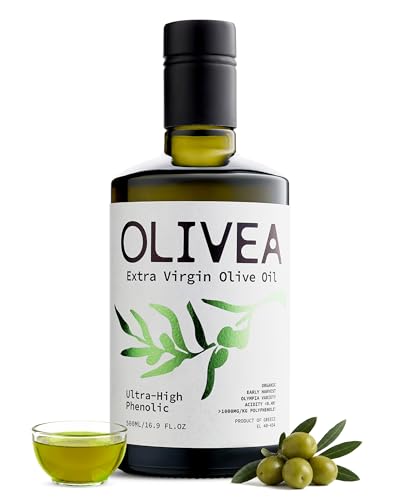
OLIVEA uses early-harvest Greek Koroneiki olives, cold-extracted within hours of picking. The brand lists 1000+ mg/kg polyphenols by NMR and over 10 mg of hydroxytyrosol per 20 g serving. It's certified USDA Organic and EU Organic, Non-GMO, and vegan. The brand positions it as a daily ritual oil, though it also works drizzled over cooked meals and salads. Keep in mind that the health benefits described on the label are the manufacturer's claims, not a substitute for advice from your doctor.
Best for: people who want olive oil as a daily routine but dislike the taste or texture.
This isn't a cooking oil. It's EVOO in vegan softgels, made from single-variety Spanish Picual olives from Jaén, cold pressed below 80.6°F within hours of harvest. Each day's two-softgel serving (1,600 mg) is sealed in its own sachet, with 30 servings per box. That makes it practical for travel or keeping at work. It's a niche pick, but it solves a real problem for people who won't swallow a spoonful of oil.
It can be, but its intense flavor is usually best appreciated raw. P.J. KABOS says its Family Reserve handles sautéing, baking, and frying with a smoke point above 400°F, while its 900+ oil is better used as a finishing oil or taken by the spoonful.
Bitterness and a peppery throat sting come from phenolic compounds. Oils with very high phenolic levels, like P.J. KABOS High Phenolic (900+), are noticeably bitter and pungent.
They are different lab testing methods and can give very different results for the same oil. For example, P.J. KABOS lists 900+ mg/kg by HPLC and 1400+ mg/kg by NMR for one oil, so only compare figures measured the same way.
Oleificio Guccione Zahara comes in a gift box, has won several awards, and has a balanced, bold flavor that most home cooks will enjoy using.
FOODOLOGY's softgels contain extra virgin olive oil in pre-portioned servings, but they're meant as a daily routine rather than for cooking or flavoring food.
FOODOLOGY
P.J. KABOS
P.J. KABOS
OLIVEA
Oleificio Guccione